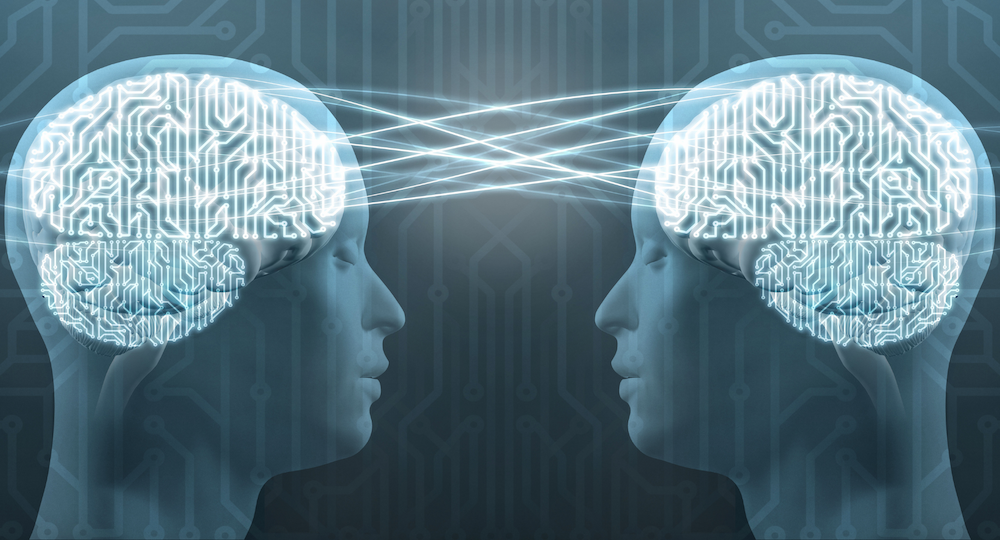
The science behind telepathic communication.
What you'll learn
1 / 5
Introduction
Telepathy is a term that comes from Greek tele, which stands for “distant,” and pathos, meaning “feeling.”
Therefore, telepathy is the human ability to feel from a distance, entailing communication between two minds without relying on visual, auditory, or tactile means.
It is also known as “thought transference.”
As you might have already experienced, telepathy is a much more common occurrence in people who have close social bonds and high levels of intimacy.
A prime example of such a relationship is that between a mother and her newborn.
Quite often, mothers report a sense of telepathic connection with their babies who are too young to have developed their own sense of identity and personal boundaries.
Spontaneous telepathic communication most frequently occurs when a member of the intimate relationship is somehow threatened.
In fact, psychiatrist Ian Stevenson says that 50 to 80 percent of telepathic communications occur during a serious crisis.
Another common source of telepathic communication is when a member of the relationship is attempting to hide something.
But, are these cases of telepathy, intuition, or just detection of very subtle clues?
2 / 5
Telepathic Dreams
Approximately 65 percent of reported telepathic experiences occur in dreams.
As is the case with many other extraordinary phenomena, it appears that the dreaming state is extremely conductive to receiving telepathic information.
“Crisis telepathy” is a well-documented category of telepathic dreams in which the dreamer dreams of someone who is awake and in danger.
The most extreme example is a “farewell dream” in which the sleeping person dreams about the death of a loved one who is actually dying.
The Society for Psychical Research (SPR) reported the findings of 149 cases of dream telepathy in their work Phantasms of the Living.
Over half of the telepathic dreams were related to death and cases of emergency, and in most cases, the dreamers and the subjects had intimate relationships.
None of the dreamers had a history of psychic abilities, nor were they prone to nightmares or other disturbing dreams.
However, upon closer investigation and over 5,000 questionnaires sent, the SPR found that fewer than 4 percent of farewell dreams coincided with someone’s death.
3 / 5
The Big Telepathic Dream Experiment
Stanley Krippner, M.D. and Montague Ulman, M.D. researched telepathic dreams under strict laboratory conditions in the 1970s and 1980s.
Their biggest telepathic dream experiments took place in 1971 at the Maimonides Dream Laboratory in New York.
One series of experiments involved an “agent” concentrating on a randomly selected painting who attempted to transmit that image to a dreaming subject in a separate room or building.
The subjects were awoken once the electrical recordings (EEG and EOG) showed that they were dreaming.
Upon comparing their dream content with the selected painting, it turned out that their dreams had a theme or other aspects that were very similar to the painting.
For example, if the painting was The Last Supper, dreams of a feast or Jesus were considered as positive results.
Over the course of twelve experiments, the investigators declared an 83.5 percent accuracy.
4 / 5
Waking State Telepathy
Telepathy has also been studied in waking states.
From 1929 to 1962, J. B. Rhine of Duke University used a deck of 25 ESP cards to study non-dream telepathy.
The cards showed five different symbols - circle, star, cross, wavy lines, and a square.
One person would randomly choose a card and tried to mentally send the symbol to another person.
Hubert E. Pearce Jr., who participated in the experiments from 1933 to 1934, claimed to have inherited his mother’s psychic abilities.
Out of 700 runs with the cards, his accuracy was 32 percent.
While that might not seem like a lot, his accuracy was 12 percent above the chance rate!
René Warcollier, another early researcher of telepathy, published a book in 1948 called Mind to Mind in which he presented many pictures of transmitted targets and drawings by the receiver.
Warcollier concluded the following:
Emotional states are easier to perceive than intellectual material;
The receiver does not need to recognize the target to draw it accurately;
Targets that move are much more powerful;
Perception of color can occur independently from the form;
Imagination often interferes with the correct perception of the target.
5 / 5
Conclusion
Laboratory studies, quite expectedly, are much less impressive than the anecdotes we hear about telepathy.
The problem is that most of them lacked features that are conducive to telepathy - relationship crisis and emergencies (both are unethical to experimentally induce).
Also, these experiments focused on emotionally neutral subjects such as cards and drawings.
Moreover, telepathy is reported to be more common in creative individuals, which is another variable that was not taken into account in these studies.
All in all, while coincidences and biases do affect the results of experiments, the data suggests that coupled consciousness might be possible, as studies using EEGs and fMRIs clearly suggest.
It is sensible to conclude that telepathy is an evolutionary advantageous ability that is of utmost importance in times of crisis.
It could be that telepathy evolved in animals a very long time ago, but, in the case of humans, it got sidelined by our analytical brains and resurfaces mostly when we are dreaming.

Reading is the first step. Practice is the rest.
Mind turns what you just read into a daily practice: reminders, practice tools and a journal that shows your progress.


Practice it
Questions about Telepathy
What is the meaning of telepathy?
Telepathy is the direct transfer of thoughts, feelings or images from one mind to another without speech, writing or any other known channel.
Is telepathy real?
It is contested. Experiments such as the Ganzfeld studies have reported results above chance, and critics dispute them. The lessons cover the experiments and how you can test yourself.
How long is the Telepathy lesson?
About 25 minutes of reading in all, in short parts of about five minutes. Read one a day, or go at your own pace in the Mind app.
Is the Telepathy lesson free?
Yes. All of it is free to read on this page and free in the Mind app, which adds practice tools and tracks your progress.
Do I need experience before starting the Telepathy lesson?
No. It starts from the basics and builds step by step, so you can begin today whether you are new to the topic or not.