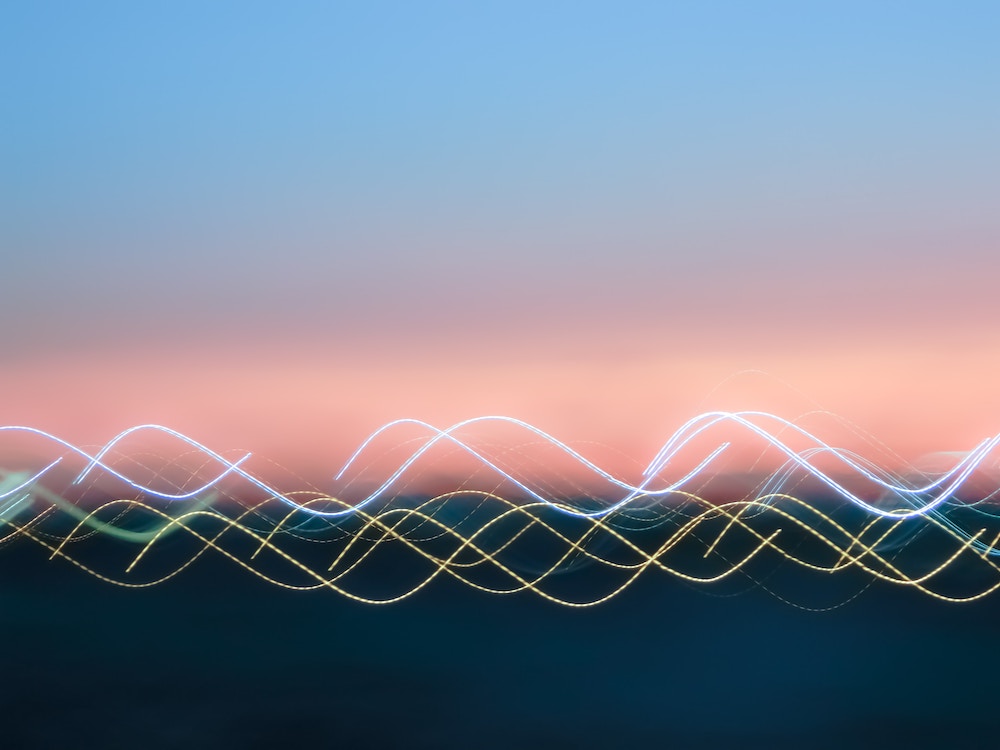
Different brain wave frequencies and their purpose.
Types of brain waves: what you will learn
1 / 7
Introduction
The brain has billions of neurons. Each of those connects to thousands of others. The communication between them happens through electrical currents.
When all these neurons are activated they produce electrical pulses. This synchronized activity results in a brain wave.
This brain activity can be observed by medical technology, such as electroencephalography (EEG).
5 main types of brain waves are: gamma, beta, alpha, theta and delta. Gamma has the highest frequency (think: high pitched flute), while delta has the lowest (think: low deep drum beat).
Frequency is measured in cycles per second - or Hertz (Hz).
Each type represents a different state of consciousness. Some brain waves are better for learning new skills, while others might be good for spiritual experience or healing.
By understanding the different types of brain waves and how they influence our mindset, we can do so much more!
2 / 7
Gamma (32 - 100 Hz)
Gamma brain waves are the fastest measurable EEG brain waves.
They are often associated with the “feeling of blessings” reported by experienced meditators, such as Buddhist Monks.
During gamma brain waves the perception is heightened and problem solving skills improve drastically!
People with high levels of gamma activity are intelligent and have strong self-control.
High gamma activity also corresponds to the peak performance of elite athletes, musicians and other high achievers.
How can we produce more gamma brain wave activity?
Love and compassion!
If you observe top athletes, you can see the passion. They just love what they’re doing!
Meditation can also help sharpen your mental abilities.
3 / 7
Beta (13 - 32 Hz)
Beta brain waves are associated with waking consciousness and reasoning.
It is a state of alertness and logic.
Beta waves are important for functioning throughout the day, but can translate into stress and anxiety.
It’s no surprise that stress is the most common health problem!
4 / 7
Alpha (8 - 13 Hz)
Alpha brain waves represent a deep relaxation state. It is also described as light trance state.
These waves occur when our eyes are closed and the mind is relaxed.
They can often be found during activities such as yoga, just before falling asleep or being creative and artistic.
Alpha waves are the gateway to your subconscious mind!
Alpha is the voice of your intuition! This becomes clearer the lower the frequency is.
5 / 7
Theta (4 - 8 Hz)
Theta waves are present during deep meditation, light sleep and the so important REM dream state. It is also described as a trance state.
It is the realm of your subconsciousness and is experienced only momentarily as you drift to sleep from alpha state, to the deep sleep delta state.
In this state, you are conscious of your surroundings, while your body is in deep relaxation.
As such, it is the perfect state for inner exploration - mind awake, body asleep.
We can see why it’s so hard to maintain this state of mind.
But studies have shown that it occurs more frequently in experienced meditation practitioners.
And there are exercises to expand the duration of conscious theta state.
6 / 7
Delta (0.5 - 4 Hz)
These are the slowest brain waves and are associated with deep (dreamless) sleep.
This is the state where healing and rejuvenation are stimulated, which is why it’s so crucial to get enough sleep each night.
In this state there is loss of body awareness.
It is the realm of your unconscious mind and the gateway to the collective unconscious (that Carl Jung and many others describe).
Information received here is often unavailable at the conscious level.
OBE practitioners often forget some of the experiences in this state when they wake up, but as soon as they drift to the delta state next time - they remember everything!
7 / 7
Conclusion
Now you better understand your own consciousness!
You know which brainwaves are associated with different states of consciousness.
You understand why meditation and relaxing is crucial for activities such as Remote Viewing, Out-of-Body Experience and others.
Shamans knew this for so long! Shamanic drumming has been used to achieve altered states of consciousness.
Repetitive and boring rhythm is used to guide the brain into different brain waves.
Technology evolved since then. There are many audio and visual tools that are used to transition between different states.
Practice it in the app
Mind turns what you just read into a daily practice: reminders, practice tools and a journal that shows your progress.


Questions about Brain Waves
What are the types of brain waves?
Five bands, from fastest to slowest: gamma (above 32 Hz), beta (13–32 Hz), alpha (8–13 Hz), theta (4–8 Hz) and delta (0.5–4 Hz).
What are delta waves?
Delta waves (0.5–4 Hz) are the slowest brain waves. They dominate deep, dreamless sleep.
What are alpha waves?
Alpha waves (8–13 Hz) appear when you are awake but relaxed, for example with your eyes closed or in light meditation.
What are gamma waves?
Gamma waves are the fastest band, above about 32 Hz, often studied around 40 Hz. They are linked to focused attention and have been measured in experienced meditators.
How long is the Brain Waves lesson?
About 35 minutes of reading in all, in short parts of about five minutes. Read one a day, or go at your own pace in the Mind app.
Is the Brain Waves lesson free?
Yes. All of it is free to read on this page and free in the Mind app, which adds practice tools and tracks your progress.
Do I need experience before starting the Brain Waves lesson?
No. It starts from the basics and builds step by step, so you can begin today whether you are new to the topic or not.